Showing posts with label Singer Featherweight. Show all posts

Friday, September 2, 2016

Where did August go?

I always seem to fall off the Blogland map for part of the summer every year, traveling and enjoying some summer weather keeps me off the computer, so I do have a few things to share.


  My featherweight addiction continues and I have acquired my third machine!  My justification is that I have two daughters, so now there is one for each of us.  (You can't argue with that can you?)  You can see more about my first and second machines here and here.)


This machine was purchased sight unseen from Moose Jaw, Saskatchewan. It was made in 1949 and has the beautiful scroll face plate.  The case is in fantastic shape with no odor and she sews beautifully.  It didn't come with all the original feet, but it did come with some really cool attachments.


The first is this automatic zig zagger with a set of extra stitch patterns.  Since a featherweight is only a straight stitch machine, so this attachment is necessary to do a zig zag style stitch.  It works well and you just exchange the red cams to change to a different design.


The other attachment is even more special.  It is called a hem stitcher.  It is truly a marvel of engineering.
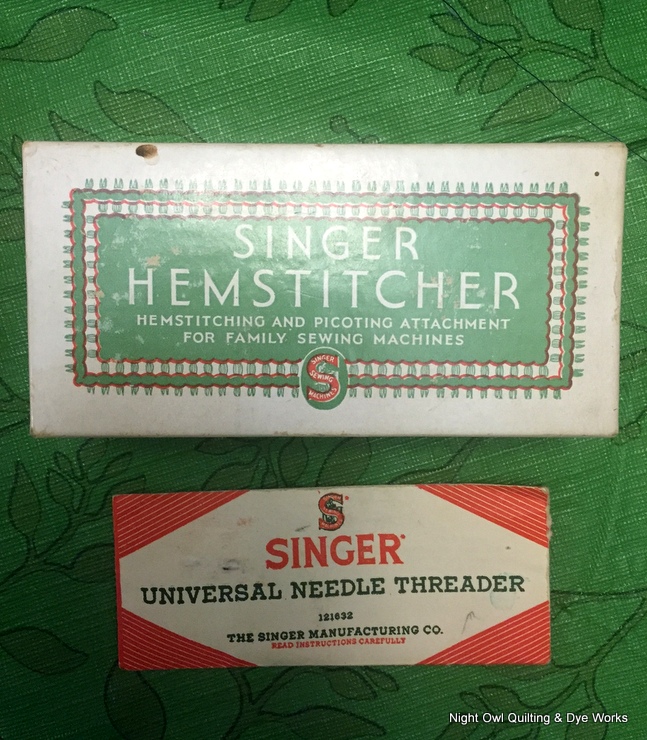

This is what was inside the box.


My understanding is that this attachment is quite collectible.  The main unit was universal and fit on any low shank Singer machine, the cover plate however is machine specific so finding one for a featherweight can be a little trickier. Mine was the right match for the featherweight.


The large piercer at the front pokes a hole in the fabric and then you stitch as the foot moves the fabric from side to side.   It does take a bit of work to get all the parts aligned just right, but mine is in good shape and works really well.  One issue that sometimes arises is the the little gripping rubber bands dry out and crack and fall off the foot. The bands on mine are like new.

Here is a short video I found online that shows it in action.

This is a more detailed and longer video that guided me to getting things set up just right.


 With a little practise I was able to create a pretty respectable example of hemstitching.


 I can't think of a reason that I would need to use this attachment, but learning about it was really interesting, I feel that I should leave you with a little quilting since its been so long.  I just finished this little lap quilt for Donna with the Come Dance with Me Panto.


Wednesday, June 29, 2016

Oops - I bought another Featherweight...


I apparently have officially joined the featherweight addicts club.  Before I owned one I didn't understand why people seemed to amass a collection, but there is just something about them that draws you in!  This machine was made in 1964 in Scotland.  It arrived with all the parts described in the owner's manual.


I found this little cutie for sale online in Nova Scotia.  The price was right for me to take a gamble on it while just seeing a few photos.  I had a good feeling about the sellers and they were willing to ship it.  The first questions that came up was how would I pay for it?  My friend Gail had a genius idea when she bought hers.  She asked the seller to send it C.O.D. through Canada Post.  There is a $7.25 fee for this service, but well worth it for the decreased risk for both buyer and seller. I know Canada Post gets a bad rap sometimes, but I couldn't have been happier. The shipping from Nova Scotia to Manitoba including C.O.D. was $40.72 and it arrived ahead of schedule.


The machine is in very good condition and the case didn't have any odour.  It hardly needed any cleaning, just a good dose of oil as it was dry as a bone.  Her stitch quality is perfect.  The bobbin winds slow at the moment but I think that can be fixed with a little tweaking of the belt.


Here are the two featherweights together.  The black one is a 1952 (you can learn more about her here) and the white a 1964 and  there are a surprising number of differences in how they are constructed. The black machine came with many more feet as standard parts, where they are listed as optional accessories for the white machine. I believe Singer was trying to find some cost saving options to keep the machines affordable and made lots of design changes as well.

 The length of the folding bed is significantly smaller on the white machine.  The side of the machine head definitely resembles more modern machines on the white.  I find the face plate and decals of the black machine more charming.  The white machine are sought after by some because there many, many fewer made.


The spool pin has a spring on the white to help hold the spool in place, and the cord is hard wired instead of being removable with  a plug on the black.  Internally the white has a belt drive and the black is gear driven.  The black one has a metal bottom with a removable felt drip pad, and the white one simply has a piece of Masonite board.


There are many differences in the cases as well besides just the obvious size difference.  The storage tray in the black case is a nice feature.  The green case is more bare bones. The biggest difference is the quality and function of the latches.  The green case is always trying to open up if you carry it just by the handle.


I made this carrying case for my first machine as I was concerned about the age of the handle as I knew I planned to travel with the machine a couple of times a month.  The green case is smaller so fits in it easily and is a necessity for travel.


I put a strap all across the bottom of the carrying case for strength and made the straps long enough to carry on my shoulder.


Saturday, February 13, 2016

My New Toy!

\

This is the new toy that arrived this week - a Singer Featherweight 221-1.  Isn't it cute?  I have to thank my hubby Nolan and brother-in-law Anton for making my dream a reality.  I have been looking for Featherweights on Kijiji and at local auction listings ever since I saw one in person.  I have been 3rd or 4th in line many times.  A couple of weeks ago Nolan spotted the listing for this one in Calgary.  The item had only been posted for 5 minutes, so I knew if I acted quickly I might have a chance.  The machine is not in pristine condition, but there seller was very upfront about the chip in the paint, and was asking a very fair price.  She even posted a video on You Tube of the machine being used, so I was very confident that is was in good working order.  My brother-in-law agreed to be the middle man, and purchased it (got a lesson in the process) and shipped it out to me.


I wanted a Featherweight to take with me to guild sewing days as I was getting tired of lugging my Janome 6600 around.  About 12 lbs as opposed to 30+ lbs is a huge difference! 


The case is in pretty good shape for something that was made in 1952!  My featherweight was born August 11, 1952 in Elizabeth, New Jersey.  63 years old. And the original key too.


The only thing that doesn't seem to be here from what would have been originally sold with the machine is the screw driver, which really is the easiest thing to replace.


The original manual is in amazing shape.


These are all the feet that were included.  The first 6 are original items, and the last three are add ons.  I don't expect to use most of these items much, but the engineering that went into them is interesting.


The one thing that I wasn't quite prepared for was the strong old smell that hit me in the face when I opened up the case.  No evidence of mold or mildew, but old oil and dust closed up for an extended period of time was not pleasant.  I did some quick research on line and found that soap and water are bad, but Kerosene and Carnuba wax are exactly what the doctor ordered!


We found some online tutorials with great information, so last night we took everything apart, tossed the old oil soaked drip pad, scrubbed and polished and it is much more pleasant to be around.  Luckily the original tube of motor lubricant was present, as it is still deemed to be usable and recommended.  A vintage machine also has many, many more oiling points that any other machine I have ever owned.


That is some chunky, gunky lubricant in the upper gears.

Today I figured out how to wind some bobbins with some modern thread and decided to try doing some real sewing.  Since I don't yet have a 1/4 foot, I attached the handy seam guide and it worked really well.


I am really impressed with the quality of the stitches, and had no trouble getting the tension adjusted with my thinner So Fine! piecing thread.


When I packed up the machine I included a bar of Irish Spring Soap in the bracket that was originally intended for an oil can. It should help freshen the case and is said to ward off bacteria.  Can't hurt right?


All ready for my next sewing day!


This is what I finished today.  I slightly adapted version of our Highway 10 Designs Detour runner.  I added two more dark chevrons to make it longer, and a small border to increase the width just a little.   Hopefully I can get it quilted soon!